

Key Takeaways
Construction loan rates in California typically range from 8% to 15%, depending on the lender type and loan structure.
Bank construction-to-permanent loans price lower (8% to 10%) but require strong credit and strict documentation.
Private money and hard money construction loans price higher (10% to 13%) but offer faster approvals, flexible underwriting, and higher leverage on complex projects.
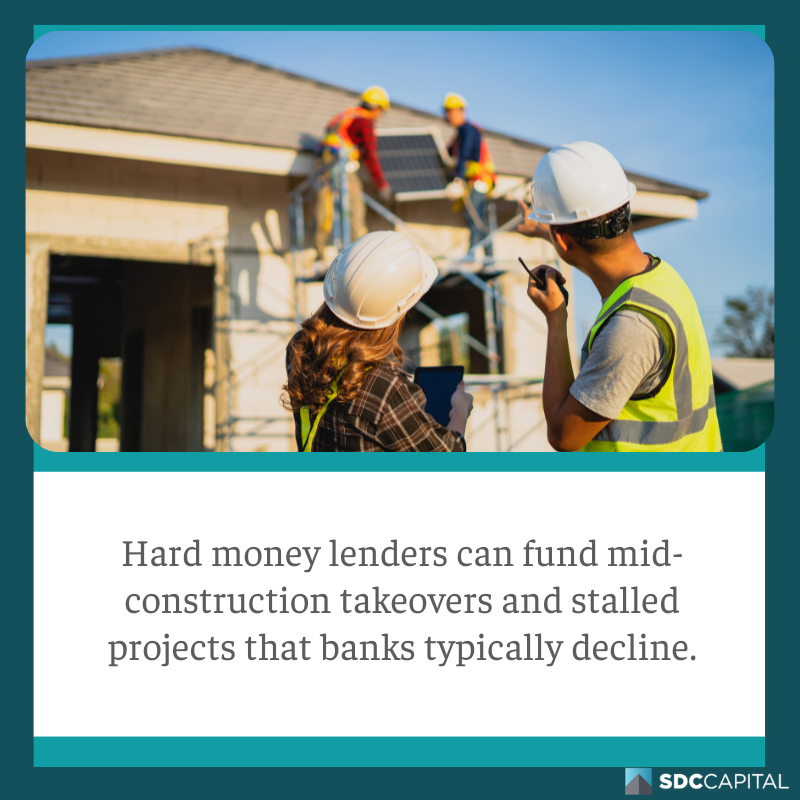
Hard money lenders can fund mid-construction takeovers and stalled projects that banks typically decline.
Rate factors include loan-to-cost, loan-to-value, borrower experience, property type, project stage, and exit strategy.
California's tight housing supply and rising construction costs, including new Title 24 requirements, are pushing more investors toward new construction financing.
SDC CAPITAL offers construction bridge loans for new builds and mid-construction projects across California.
Building a property from the ground up, or picking up where another developer left off, comes with one persistent question: what will it cost to borrow the money?
Construction loan rates in California depend on far more than a single number lenders quote over the phone. Loan type, project stage, borrower experience, and property location all shape the final rate a builder or investor pays.
This guide breaks down how construction loan rates work in California today, what separates private money financing from traditional bank construction loans, and what real estate investors should expect when budgeting for a new build or mid-construction project.
Construction Loan Rates in California in 2026
As of 2026, construction loan rates in California typically range from 8% to 15%, depending on the type of lender and the loan structure.
Bank construction-to-permanent loans: roughly 8% to 10%, reserved for experienced developers with strong credit and 65% to 75% loan-to-cost.
Debt fund and private money construction loans: roughly 10% to 13%, with higher leverage available (often 75% to 85% loan-to-cost).
Hard money construction loans: roughly 10% to 12%, for developers who need speed, flexibility, or don't have the documentation a bank requires.
For comparison, Freddie Mac's Primary Mortgage Market Survey showed the 30-year fixed-rate mortgage averaging 6.55% as of July 16, 2026.
Construction loans price well above conventional mortgage rates because they carry more risk for the lender. The property doesn't exist yet, or isn't finished, so there's no stabilized asset to secure the loan the way a completed home provides.
Even after recent rate cuts, construction loan interest rates in California have continued to hover between 10% and 12%, particularly in markets where contractor shortages and material costs are squeezing project budgets. That's a helpful benchmark for investors comparing quotes from private lenders.
Bank vs. Private Money: Two Different Paths to the Same Project
Not every builder qualifies for a bank construction loan, and not every project needs one.
Bank construction-to-permanent loans bundle the construction phase and the long-term mortgage into a single closing. Rates are lower, but qualification is strict: strong credit, verifiable income, a licensed general contractor, and a detailed budget the underwriter approves line by line.
On the other hand, private money and hard money construction loans are asset-based. Lenders look primarily at the property's value, the completed project's projected worth, and the borrower's plan, rather than tax returns or W-2 income.
This is why investors with multiple ongoing projects, self-employed borrowers, or developers completing a stalled build from a prior contractor often turn to private lenders instead.
SDC CAPITAL structures small balance construction loans for both ground-up builds and mid-construction takeovers across California, funding based on the project's merits rather than a rigid underwriting checklist.
5 Main Benefits of Hard Money Lending in Construction Loans
For many California investors, hard money construction loans offer practical advantages that outweigh the higher rate, especially when timing and flexibility matter more than securing the lowest possible cost of capital.
1. Faster approvals and funding
Hard money lenders evaluate the property and project directly, which means approvals often take days instead of the weeks or months a bank underwriting process requires.
That speed can be the difference between securing a piece of land or a distressed build and losing it to another buyer.
2. Flexible underwriting
Self-employed borrowers, investors with multiple active projects, or developers without a long paper trail of tax returns often struggle to meet bank documentation requirements. Hard money lenders focus on the collateral and the plan, not a rigid income checklist.
3. Higher leverage on complex projects
Ground-up builds, mixed-use developments, and mid-construction takeovers frequently carry risk profiles that banks avoid altogether. Hard money lenders are often willing to fund these scenarios where a traditional lender would decline the deal outright.
4. Draw schedules built around the project, not the calendar
Private lenders can structure draws to match actual construction milestones, which keeps funding aligned with progress rather than forcing a rigid disbursement timeline.
5. A path forward for stalled projects
When a previous contractor runs out of funding or a project stalls mid-build, hard money lenders can step in to evaluate the remaining scope of work and fund completion, something most banks are not equipped to underwrite.
For investors weighing the combined loan-to-value across a portfolio, this flexibility can also make it easier to keep multiple projects moving at once without waiting on a single lender's slower approval cycle.
What Affects Your Construction Loan Rate
Several factors determine where a specific project lands within the broader rate range:
Loan-to-cost (LTC) and loan-to-value (LTV): Lower leverage typically earns a lower rate. A project at 55% to 60% LTV might price several points below one at 75% LTC.
Borrower experience: Developers with a track record of completed projects generally receive more favorable terms than first-time builders.
Property type and location: Single-family ground-up builds, multifamily developments, and mixed-use projects each carry different risk profiles. Coastal and high-demand metro locations may price differently than inland markets.
Project stage: Ground-up construction, mid-construction takeovers, and near-completion projects are underwritten differently. A partially built property with a clear scope of remaining work can sometimes secure better terms than a raw land purchase.
Exit strategy: Whether the plan is to sell, refinance into a permanent loan, or hold as a rental affects how a lender prices the loan.
Borrowers using blanket loans to finance multiple properties or phases under one structure may also see different rate considerations, since the collateral pool changes the lender's risk calculation.
Why California's Housing Market Is Pushing Investors Toward New Construction
The median home price in California reached $782,221 in May 2026, up 2.3% year over year, with housing supply down 5.6% year over year. Limited inventory in many metro areas is one reason more investors are choosing to build rather than compete for scarce existing homes.
This dynamic matters directly for construction financing. When resale inventory tightens, ground-up construction and completion projects become a more attractive strategy for investors trying to add value in a competitive market.
That shift keeps demand for construction loans steady, even as rates remain elevated compared to conventional purchase mortgages.
Rising Construction Costs and Title 24 Compliance
Construction loan rates are only part of the budgeting picture. Material and labor costs, along with regulatory requirements, directly affect how much a project needs to borrow in the first place.
California's 2025 Building Energy Efficiency Standards (Title 24, Part 6) took effect January 1, 2026, with new requirements around heat pump systems, electrification readiness, and building envelope performance.
Projects that don't account for these standards early in planning often face redesign costs and schedule delays, which in turn affect how much financing a builder needs and for how long.
Combined with ongoing labor shortages and material price pressure across the state, these factors make it important for investors to build a realistic contingency into their construction budget, and to work with a lender who understands how project stage and completion risk factor into loan terms.
Borrowers can also review current hard money loan rates to compare how construction pricing fits within the broader private lending market.
How to Qualify for a Construction Loan in California
While requirements vary by lender, most private money and hard money construction loans in California require:
A clear project scope, budget, and timeline
Evidence of experience with similar projects (for the borrower, contractor, or both)
A reasonable loan-to-cost or loan-to-value ratio, typically 50% to 85% depending on the lender
A viable exit strategy, whether that's sale, refinance, or long-term hold
Because private lenders evaluate the project and collateral directly, approval timelines are often measured in days rather than weeks, which matters when a construction timeline is already tight.

Get Financing for Your Next California Construction Project
If you're planning a new build, need to complete a stalled project, or want financing structured around your project rather than a rigid bank checklist, SDC CAPITAL can help.
Visit sdcfinance.com/get-a-quote or call 424-304-1072 to discuss your construction loan options with our team.
Frequently Asked Questions
What is the average construction loan rate in California?
Construction loan rates in California generally range from 8% to 15%, depending on whether the loan comes from a bank, a debt fund, or a private/hard money lender. Private money construction loans typically fall between 10% and 13%.
Are construction loan rates higher than mortgage rates?
Yes. Construction loans carry more risk for lenders since the property isn't complete, so rates run several percentage points above conventional mortgage rates. For reference, the 30-year fixed mortgage averaged 6.55% in mid-July 2026, while construction loan rates in California typically start around 8%.
How is a private money construction loan different from a bank construction loan?
Bank construction loans require strong credit, verifiable income, and strict underwriting, but offer lower rates. Private money construction loans are asset-based, focusing on the property and project rather than the borrower's financial documentation, which allows for faster approval at a higher rate.
Can I get a construction loan to finish a partially built property?
Yes. Private money and hard money lenders often work with borrowers completing a stalled or partially built project, evaluating the remaining scope of work and the completed value rather than requiring the loan to start from raw land.
What credit score do I need for a construction loan in California?
Bank construction loans typically require good to excellent credit. Private money and hard money construction lenders place more weight on the property's value and the project's viability, making them accessible to borrowers who might not qualify for traditional bank financing.