
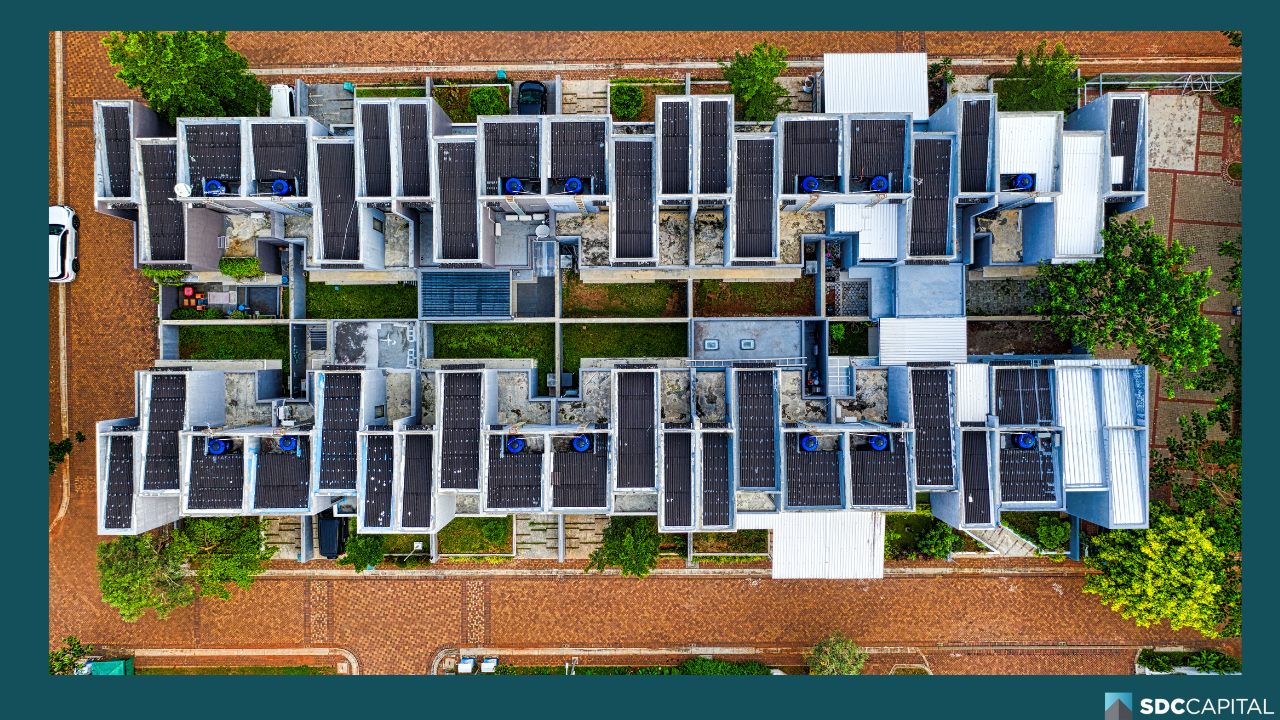
Mixed use financing is a key strategy in today’s evolving commercial real estate market. As urban and suburban landscapes shift toward more walkable, sustainable, and vibrant environments, mixed-use properties—those that masterfully blend residential, commercial, retail, and often office space—have captured the interest of developers, investors, and lenders alike.
According to JLL Research, urban neighborhoods now account for 54% of the most expensive streets in the United States.
Jacob Rowden, JLL’s U.S. Office Research Manager, said, “More than ever, cities and developers are now seeking to create symbiotic ecosystems of vibrant real estate that create benefits across multiple uses.”
This reinforces why mixed-use developments in urban cores continue to attract capital.
What Is a Mixed-Use Property?
A mixed-use property is a type of investment property that integrates two or more different types of real estate uses within a single building or development.
Common configurations include retail storefronts on the ground floor with apartments or condos above, as well as office space combined with residential units.
In larger-scale projects, these developments include full live-work-play districts that weave housing, shops, and amenities into a cohesive neighborhood.
Types of Mixed Use Properties / Mixed Use Zoning
Typically, when you invest in mixed-use developments, you are not limited to the types of properties you can include.
Vertical mixed-use – Different uses stacked within one structure, such as retail at the street level with residences above.
Horizontal mixed-use – Separate buildings within a single site, each serving a distinct purpose (e.g., retail plaza and residential buildings within one development).
Live-work spaces – Units designed for both residential and business use under one roof.
These property types cater to modern preferences for convenience, walkability, and integrated lifestyles.
Types of Mixed Use Financing
Securing mixed use financing for this type of real estate involves specialized lending products tailored to properties that don’t fit neatly into traditional residential or commercial categories.
Common Loan Types for Mixed Use Financing
1. Conventional / Bank Loans
These are the standard commercial loans with competitive terms typically up to 75% loan-to-value (LTV), amortized over 15–30 years.
2. Bridge Loans
Bridge loans, also often referred to as hard money loans, are short-term financing to carry the property to stabilization or permanent financing, often interest-only. It typically lasts for 6-24 months, depending on the agreement.
Make sure to do your research when working with a bridge lender to ensure you get the best deal.
With this, SDC Capital can help. For inquiries, contact 424-304-1072 or email info@sdccap.com
3. Construction Loans
Construction loans provide capital for ground-up development or redevelopment before long-term financing is secured. Construction loans can also fall under bridge loans.
4. SBA & Government-Backed Options
These are programs like SBA 7(a) or other agency loans that may offer attractive terms for eligible projects.
5. CMBS & Agency Loans
These include commercial mortgage-backed securities (CMBS) and life company loans for larger, stabilized mixed-use assets.
Some lenders also offer mezzanine debt, equity financing, or USDA programs depending on project scope, leverage needs, and borrower qualifications.
Benefits of Bridge Loans for Mixed Use Financing
Bridge loans are uniquely suited for mixed-use financing because they help investors and developers navigate transitional phases — from acquisition to stabilization — that traditional loans often can’t handle efficiently.
They act as a short-term, flexible capital solution that bridges the gap between purchase and long-term financing.
Why Bridge Lending Matters for Mixed-Use Deals
Bridge lending helps property owners act fast, adapt to changing conditions, and unlock value especially in today’s competitive and fast-moving real estate markets.
Here are the top reasons why bridge lending matters for mixed-use deals:
1. Fast Access to Capital
Speed is the hallmark of bridge lending, especially when time is critical:
Closings in as little as 7–14 days, compared to 30–60+ days with traditional lenders.
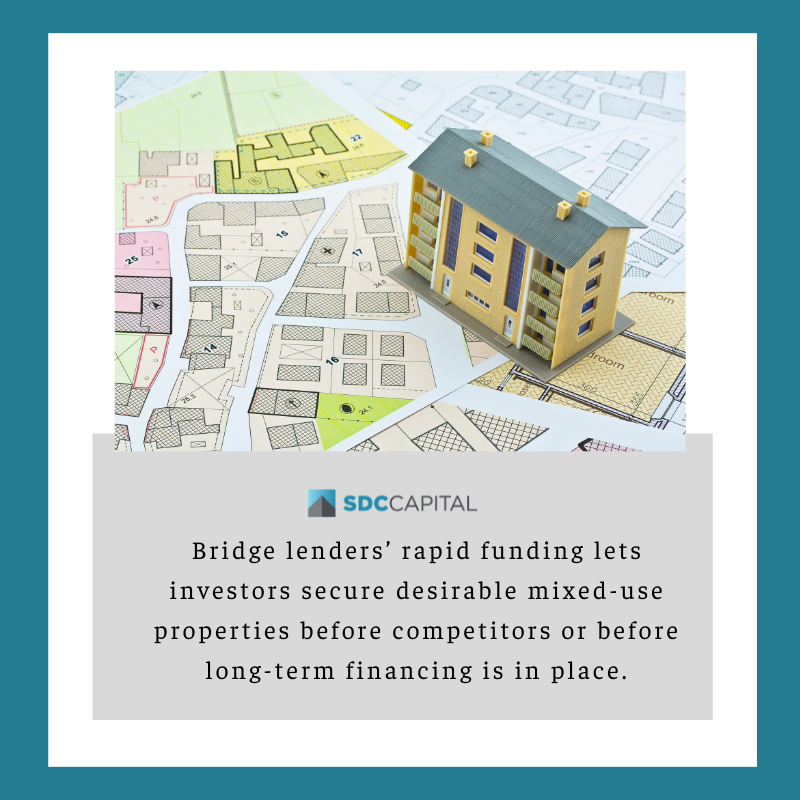
This rapid funding lets investors secure desirable mixed-use properties before competitors or before long-term financing is in place.
Quick access can be decisive when sellers require fast escrow timelines or when market opportunities emerge unexpectedly.
Why it matters: In competitive markets, timing wins deals. Bridge financing delivers speed banks often can’t match.
2. Flexible Underwriting for Complex Properties
Mixed-use assets have multiple income components (retail + residential + office), which can complicate traditional loan underwriting.
Bridge lenders tend to:
Emphasize property value and potential over rigid cash-flow criteria.
Evaluate future stabilized income rather than only current performance.
Accept properties with higher vacancy or transitional phases, such as lease-up periods or renovations.
Why it matters: This flexibility makes bridge loans ideal for repositioning or value-add strategies that might disqualify a project from conventional financing.
3. Capital for Value-Add and Renovations
Bridge lending isn’t just for acquisition. It also funds property improvements that increase future revenue and value:
Renovations that raise occupancy rates or rents.
Adaptive reuse of outdated retail or commercial spaces within mixed-use buildings.
Tenant improvements that boost long-term lease rates.
Result: These improvements can lead to a higher appraisal and stronger long-term financing terms once the property stabilizes.
4. Strategic Flexibility and Market Advantage
Bridge loans give borrowers strategic options that traditional financing rarely offers:
Interest-only payments during the term (in many cases).
Customized loan structures tailored to the property’s timeline and needs.
No long-term commitment — ideal for projects with a clear exit plan, such as refinancing into permanent debt after stabilization.
5. Short-Term Financing Without Giving Up Control
Because bridge loans are short-term and structured around property value (not personal credit), borrowers often:
Preserve equity and ownership control while executing a business plan.
Avoid selling equity or bringing in partners just to secure capital.
This capital structure advantage is especially useful for mixed-use projects with nuanced cash flows and phased income ramps.
According to Lightning Docs AI, bridge loan volumes grew significantly, with average loan sizes increasing and closing times sharply faster than traditional mortgages.
Mixed Use Financing: Work With SDC Capital
At SDC Capital, we specialize in structuring tailored mixed use financing solutions that align with your development goals.
Whether you’re acquiring a property, refinancing an existing asset, or building a brand-new project, we help design a financing structure that optimizes terms and meets lender expectations.
How SDC Capital Helps
Expert in-house underwriting for both residential and commercial cash flows
Access to diverse capital sources including bridge, permanent, and construction options
Customized strategies for complex mixed-use structures
Fast execution and deal packaging to meet market timelines (Funding in as fast as 7 days!)
Our team understands the nuanced risk profiles and income models of mixed-use assets. Let’s put that expertise to work for your next project.
Have a deal scenario? Send your details here or call 424-304-1072.
Answering Your FAQs About Mixed Use Financing
Q: Do mixed-use loans require higher down payments than traditional loans?
A: Many lenders require a 20–30% down payment depending on property mix and risk profile, which can be higher than standard residential mortgages.
Q: Can I refinance a mixed-use property?
A: Yes. Many mixed-use loans support refinancing or cash-out options if the property demonstrates strong income performance.
Q: Are mixed-use loans only for large developments?
A: No. Loans are available for both small live-work buildings and large urban complexes, though terms vary widely by lender and property size.
Q: What’s the underwriting focus for mixed-use financing?
A: Lenders evaluate tenant quality, lease structures, and net operating income (NOI) across all property uses to assess overall project viability.
--