

Key Takeaways
Debt yield is a property's net operating income (NOI) divided by the loan amount, shown as a percentage.
Many commercial lenders set a minimum debt yield between 8% and 12%, and CMBS lenders often require around 10% or higher.
Unlike DSCR and LTV, debt yield is not affected by interest rates, amortization, or appraised value.
Lenders often use debt yield to set the maximum loan amount: NOI divided by the required debt yield.
When a deal falls short of a bank or CMBS debt yield floor, a bridge loan can give the borrower time to raise NOI and refinance later.
If you own or broker commercial property in California, there is a good chance a refinance or acquisition is on your desk right now.
According to the Mortgage Bankers Association, approximately $875 billion in commercial and multifamily mortgage debt, about 17% of the roughly $5 trillion outstanding, is expected to mature in 2026.
Many of those borrowers will find that one number decides their loan amount more than any other: debt yield.
This guide explains what debt yield is, how to calculate it, what lenders look for, and what your options are when a deal does not meet a lender's debt yield requirement.
What Is Debt Yield?
Debt yield is a commercial real estate lending metric that compares a property's annual net operating income to the total loan amount.
It answers a simple question from the lender's side of the table: if the borrower defaulted and the lender took over the property tomorrow, what return would the property's income produce on the money lent?
A 10% debt yield, for example, means the property's NOI equals 10% of the loan balance each year. In theory, that income alone would return the lender's principal in about ten years, with no rent growth and no sale.
Debt yield is most common in commercial lending for multifamily, retail, office, and industrial properties. CMBS lenders, life insurance companies, and many banks use it alongside other underwriting tests.
If you are new to how different lenders operate, our overview of the 4 main types of real estate loans is a helpful starting point.
The Debt Yield Formula
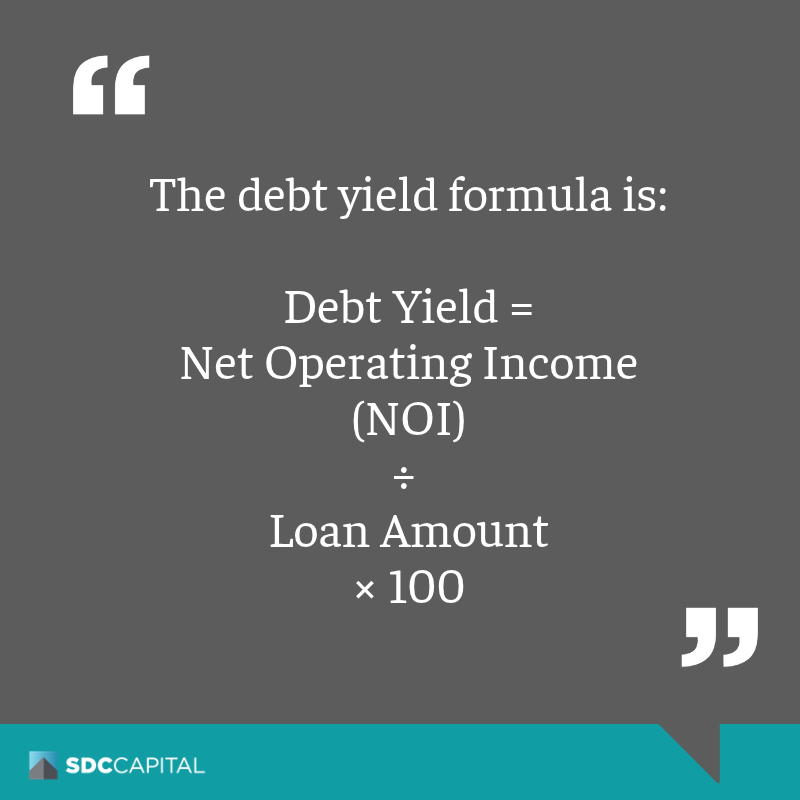
The debt yield formula is:
Debt Yield = Net Operating Income (NOI) ÷ Loan Amount × 100
Net operating income is the property's gross rental and other income minus operating expenses such as property taxes, insurance, repairs, management, and utilities. It does not include debt service, income taxes, or capital expenditures.
Loan amount is the total principal requested or outstanding.
One detail to confirm with any lender: some institutional lenders calculate debt yield on net cash flow instead of NOI. Net cash flow subtracts capital reserves first, which produces a slightly lower debt yield.
When you compare your own numbers to a term sheet, make sure both use the same income figure.
Debt Yield Calculation Example
Say an investor wants to refinance a 20-unit apartment building in Sacramento.
Annual NOI: $600,000
Requested loan amount: $7,000,000
Debt yield = $600,000 ÷ $7,000,000 × 100 = 8.57%
Now assume the property is valued at a 5.5% cap rate, which puts the value at about $10.9 million. The requested loan works out to roughly 64% loan to value, which many lenders would accept.
But if the lender requires a 10% minimum debt yield, the math changes. The deal passes the LTV test and still falls short on debt yield. This is common in California, where low cap rates produce high property values relative to income.
A Quick Shortcut: Debt Yield, Cap Rate, and LTV
There is a useful relationship between these three numbers:
Debt Yield = Cap Rate ÷ LTV
In the example above, 5.5% ÷ 0.642 equals about 8.57%. This shortcut shows why lower cap rates make debt yield harder to meet. At the same leverage, a lower cap rate always means a lower debt yield.
What Is a Good Debt Yield?
There is no single standard, but common lender ranges look like this:
CMBS and conduit lenders: often around 10% or higher
Agency multifamily lenders: often 8% to 9%
Life insurance companies on prime assets: sometimes below 8%
General commercial range: roughly 8% to 12%, depending on property type, market, and asset quality
A higher debt yield means lower risk for the lender. Transitional and value-add properties usually face higher debt yield requirements than stabilized properties.
Lenders also adjust their minimums based on market conditions. CMBS lenders in particular have reason to stay careful.
The 30+ day delinquency rate among KBRA-rated U.S. private label CMBS was 7.7% in October 2026, and the broader distress rate, which includes current loans in special servicing, stood at 10.3% (KBRA).
With that much stress in their portfolios, CMBS lenders have little reason to loosen their debt yield floors.
Debt Yield vs. DSCR vs. LTV
Debt yield is one of three main tests commercial lenders use. Each answers a different question.
Loan to value (LTV) asks how much of the property's value is financed. It depends on an appraisal. If the property has more than one loan against it, lenders also look at combined loan to value.
Debt service coverage ratio (DSCR) asks whether the property's income covers the annual loan payments. It depends on the interest rate and amortization schedule.
Debt yield asks how much income the property produces relative to the loan. It depends only on NOI and loan amount.
| Factor | Debt Yield | DSCR | LTV |
|---|---|---|---|
| Formula | NOI ÷ Loan Amount | NOI ÷ Annual Debt Service | Loan Amount ÷ Property Value |
| What it measures | Income relative to the loan | Ability to cover payments | Share of value financed |
| Affected by interest rate? | No | Yes | No |
| Affected by amortization? | No | Yes | No |
| Affected by appraised value? | No | No | Yes |
| Common lender target | 8% to 12% | 1.20x to 1.25x minimum | Often 60% to 75% |
Why do lenders care about debt yield when they already have DSCR and LTV? Because the other two can be stretched.
A longer amortization or lower interest rate can make DSCR look healthier without any change in the property's income. Rising property values can make LTV look safer even when income has not kept up.
Debt yield gained wide use among CMBS lenders after the 2008 financial crisis for exactly this reason: it ties the loan to actual income, not to rates or market sentiment.
How Lenders Use Debt Yield to Size a Loan
In practice, lenders run debt yield in reverse to find the largest loan a property can support:
Maximum Loan Amount = NOI ÷ Required Debt Yield
Back to the Sacramento example with $600,000 of NOI:
Required Debt Yield
Maximum Loan
8%
$7,500,000
9%
$6,666,667
10%
$6,000,000
At a 10% floor, the borrower who asked for $7 million would be offered about $6 million, leaving a $1 million gap to fill with equity or another source.
Most lenders size a loan using all three tests and offer the lowest result. Debt yield is often the one that sets the limit, especially when cap rates are low. It is one part of a broader review that also covers the borrower, the property, and the business plan. Our guide on what underwriting in real estate involves walks through the full process.
It also helps to know what does not change debt yield. Lowering the interest rate, extending the amortization, or lengthening the loan term will not raise it. The only levers are higher NOI or a smaller loan.
What to Do If Your Deal Falls Short of a Debt Yield Requirement
Falling short of a lender's debt yield floor does not always mean the deal is dead. Common options include:
Bring more equity. A smaller loan raises the debt yield. This is the simplest fix, but it ties up more of your cash.
Raise NOI before applying. Higher rents, lower vacancy, and tighter expense control all raise debt yield. Keep in mind that many banks and CMBS lenders underwrite trailing income, so improvements may need several months of operating history before they count.
Add subordinate financing. Mezzanine debt or preferred equity can fill part of the gap, usually at a higher cost.
Use a bridge loan. Short-term financing can close the deal now and give you time to stabilize the property before refinancing into permanent debt.
Timing matters here. Banks reported tightening lending standards, on net, for all commercial real estate loan categories in the Federal Reserve's October 2026 survey, including construction and land development, nonfarm nonresidential, and multifamily loans.
At the same time, alternative lenders such as private credit and specialty finance providers have shown continued interest in commercial real estate, particularly where owners need financing that traditional lenders are less willing to offer.
For a real example of private financing in action, see how SDC CAPITAL funded a $1.1M cash-out refinance in Los Angeles.
How Bridge Loans Help Value-Add Deals Reach Permanent Financing
Value-add properties are where debt yield problems show up most often. A building with below-market rents or high vacancy may have strong upside, but its current NOI will not support the permanent loan the investor needs.
Here is how a bridge strategy can work:
Close with a bridge loan. The investor buys or refinances the property using short-term financing based mainly on the property's value and business plan.
Execute the plan. Over 12 to 18 months, the investor renovates units, raises rents to market, and fills vacancies.
Refinance into permanent debt. Once NOI has grown and the property shows a stable operating history, the investor refinances with a bank, agency, or CMBS lender that can now approve the loan on its debt yield test.
Using the earlier example, if the Sacramento owner raises NOI from $600,000 to $750,000, the same 10% debt yield floor now supports a $7.5 million permanent loan instead of $6 million.
The refinance is the step that makes or breaks this plan, so it should be mapped out before the bridge loan closes.
Our guide on building a bridge loan exit strategy covers how to plan it, and our breakdown of typical hard money loan terms in California explains the rates, fees, and timelines to expect.
Get Financing When Your Deal Needs More Time
When a bank or CMBS lender's debt yield floor stands between you and your next deal, SDC CAPITAL can help.
As a California-based private lender, SDC CAPITAL provides bridge loans from $250,000 to $5 million on multifamily, retail, office, and industrial properties. Leverage goes up to about 65% LTV on stabilized properties and up to 75% LTV on value-add purchases, with first and second liens available and typical terms of 12 to 18 months.
Request a quote at sdcfinance.com/get-a-quote or call 424-304-1072 to talk through your deal.
Frequently Asked Questions About Debt Yield
What is a good debt yield for a commercial real estate loan?
Most lenders look for a debt yield between 8% and 12%. CMBS lenders often require about 10% or higher, while agency multifamily lenders may accept 8% to 9%. Requirements vary by property type, location, and market conditions.
How do you calculate debt yield?
Divide the property's annual net operating income by the total loan amount, then multiply by 100. A property with $500,000 of NOI and a $5,000,000 loan has a 10% debt yield.
Is a higher debt yield better?
For lenders, yes. A higher debt yield means the property produces more income relative to the loan, which lowers the lender's risk. For borrowers, a higher debt yield usually comes from a smaller loan or higher NOI.
What is the difference between debt yield and cap rate?
Both use NOI. A cap rate divides NOI by the property's value and reflects the owner's return. Debt yield divides NOI by the loan amount and reflects the lender's return if it took over the property.
Do interest rates affect debt yield?
No. Debt yield uses only NOI and loan amount, so changes in interest rates, amortization, or loan term have no effect on it.
Do bridge and private lenders use debt yield?
Some do, but many private and bridge lenders focus more on the property's value, the borrower's business plan, and the exit strategy. That flexibility is why bridge loans are often used for properties that do not yet meet bank or CMBS debt yield requirements.