

A gap loan, also known as gap financing, fills the financing shortfall between a senior loan (bridge loan) and total project costs. It sits between senior debt and borrower equity in the capital stack
Gap loans offer speed, flexibility, and increased leverage.
They are best suited for transitional or time-sensitive real estate deals.
A strong exit strategy is essential to managing risk. Compared to traditional financing, gap loans close significantly faster, have shorter terms, and are focused on asset value than credit history.
In real estate financing, timing and capital structure can make or break a deal. When a primary loan doesn’t fully cover a project’s capital needs, a gap loan can step in to bridge the difference without forcing borrowers to walk away from an otherwise solid opportunity.
This guide breaks down what a gap loan is, how it works, when it’s used, and how it compares to other financing options.
What is a Gap Loan in Real Estate? (AKA Gap Financing)
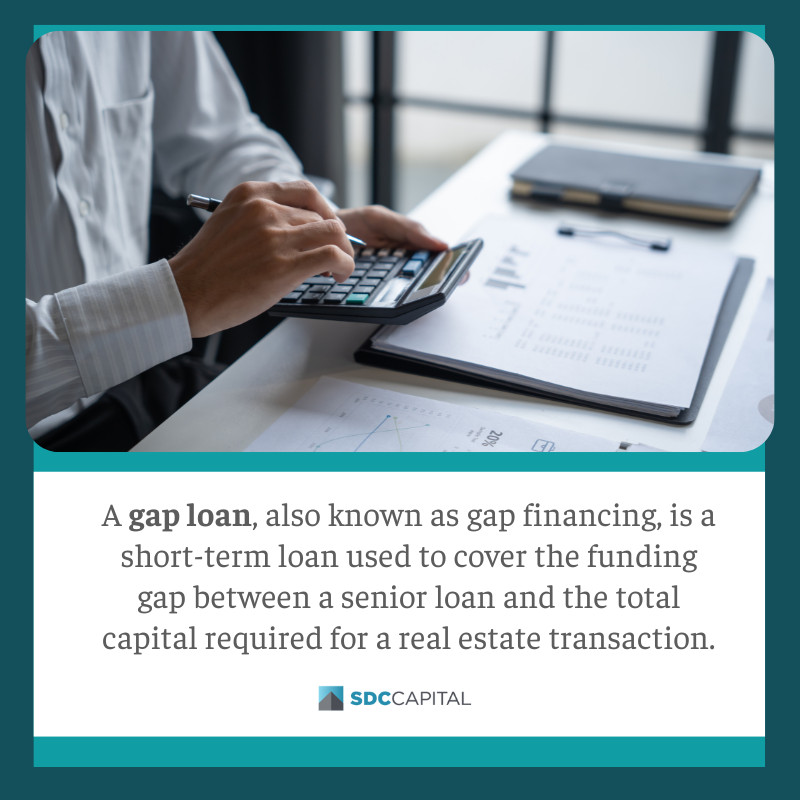
A gap loan, also known as gap financing, is a short-term loan used to cover the funding gap between a senior loan and the total capital required for a real estate transaction.
In most cases, the senior lender will only finance up to a certain loan-to-value (LTV) or loan-to-cost (LTC). When additional capital is needed, a gap loan fills that shortfall.
Gap loans typically sit behind the senior loan but ahead of borrower equity in the capital stack. They are commonly used in commercial real estate, value-add projects, acquisitions, refinances, and transitional properties.
Pros and Cons of a Gap Loan
Like any financing tool, gap loans come with advantages and trade-offs:
Pros of Gap Loans
Increases purchasing power without requiring additional equity
Faster access to capital compared to traditional financing. In trusted lending firms like SDC CAPITAL, loans can be closed in as little as 7 days.
Flexible underwriting, often asset-based
Helps borrowers preserve cash for reserves or renovations
Cons of Gap Loans
Higher interest rates than senior loans. Because these loans carry more risks, higher interest rates are necessary.
Shorter loan terms. Typical loan terms for gap loans range from 6 months to 2 years.
Adds complexity to the capital stack
Requires strong exit strategy to mitigate risk. Whether your planned exit strategy is refinancing or traditional loans, you as a borrower are required to declare a strong exit plan to get swiftly approved.
Common Scenarios for Using a Gap Loan
Gap loans are most often used when speed, leverage, or flexibility is critical.
Common scenarios include:
Acquisition gaps when bridge financing doesn’t reach the needed leverage
Refinancing a property with existing debt that exceeds new loan proceeds
Covering construction or renovation cost overruns
Value-add or transitional assets not yet stabilized
Competitive purchase situations where fast execution matters
How Do You Get a Gap Loan?
Obtaining a gap loan typically involves fewer steps than traditional financing, but lenders still focus heavily on risk and exit strategy.
Most lenders will evaluate:
Property value and condition
Existing loan terms
Borrower experience and track record
Business plan and repayment strategy
Loan-to-value and loan-to-cost metrics
Because gap loans are short-term, lenders place significant weight on how the loan will be repaid, whether through refinance, sale, or stabilization.
If you’re unsure whether a gap loan is the right fit for your deal, speaking with an experienced lender can help clarify next steps. Contact info@sdccap.com to learn more.
Gap Loans vs. Other Financing Options
Gap loans are often compared to other real estate financing tools. Understanding the differences helps borrowers choose the right structure.
Gap Loan vs. Bridge Loan
A bridge loan is typically a senior, short-term loan used to acquire or refinance a property during a transitional phase. Gap loan is considered the junior loan.
| Bridge Loan | Gap Loan |
|---|---|
| Serves as the primary loan | Serves as supplemental real estate funding |
| Typically carries lower interest rates | Carries higher interest rates |
Further, gap loans also fill leverage gaps that bridge loans don’t cover. In many deals, a gap loan is layered on top of a bridge loan to complete the capital stack.
Gap Loan vs. Traditional Financing
Traditional financing, such as funds you borrow from banks or agency loans, prioritizes long-term stability and lower interest rates.
| Gap Loan | Traditional Loan |
|---|---|
| Gap loans close significantly faster, especially when compared to traditional loans | Traditional loans can take up to 45 days to close |
| Higher rates, but shorter terms | Longer terms with lower rates |
| More focused on asset value than borrower income | Focused on borrower income and credit history |
Frequently Asked Questions About Gap Loans
Who uses gap loans?
Gap loans are commonly used by:
Commercial property owners
Developers and value-add operators
Borrowers executing time-sensitive acquisitions
They are most effective for experienced borrowers who understand short-term financing and exit strategies.
How fast can a gap loan close?
Gap loans can often close within days to a few weeks, depending on deal complexity, documentation, and lender requirements. They are significantly faster than traditional bank financing. This makes them a better choice for those looking for quick financing options.
Are gap loans risky?
Gap loans carry higher risk than senior loans due to their position in the capital stack and shorter terms.
However, when used strategically, with conservative leverage and a clear exit plan, they can be an effective financing tool rather than a liability.