
Key Takeaways
ADU financing with hard money is a short-term, asset-based loan that funds the design, permitting, and construction of an accessory dwelling unit, often sized on the property's value after the ADU is complete.
Private lenders release construction funds through a draw schedule, usually with interest-only payments over a 6-to-24-month term.
Hard money fits investors who need speed, own rental or multifamily properties, or fall outside bank and agency guidelines.
Private lenders look at equity, projected value, and a detailed budget with a contingency reserve before approving ADU financing.
Compared to HELOCs, cash-out refinances, and bank construction loans, hard money costs more but closes faster and works on property types conventional programs exclude.
Accessory dwelling units (ADUs) have become one of the most active corners of California housing.
According to California Department of Housing and Community Development (HCD) data, the number of ADUs permitted each year statewide grew from 1,336 in 2016 to 30,354 in 2024, and ADUs made up more than 26.6% of all homes permitted in California in 2024.
For real estate investors, that growth points to a clear opportunity:
Add a rentable unit to an existing property
Raise its value
Increase cash flow without buying new land
The challenge is paying for the build.
Most ADU financing guides are written for homeowners using bank products, which leaves investors with limited equity, multi-unit properties, or tight timelines looking for another path.
This guide explains how ADU financing with hard money works, when it makes sense, what private lenders require, and how it compares to traditional options.
What Is ADU Financing?
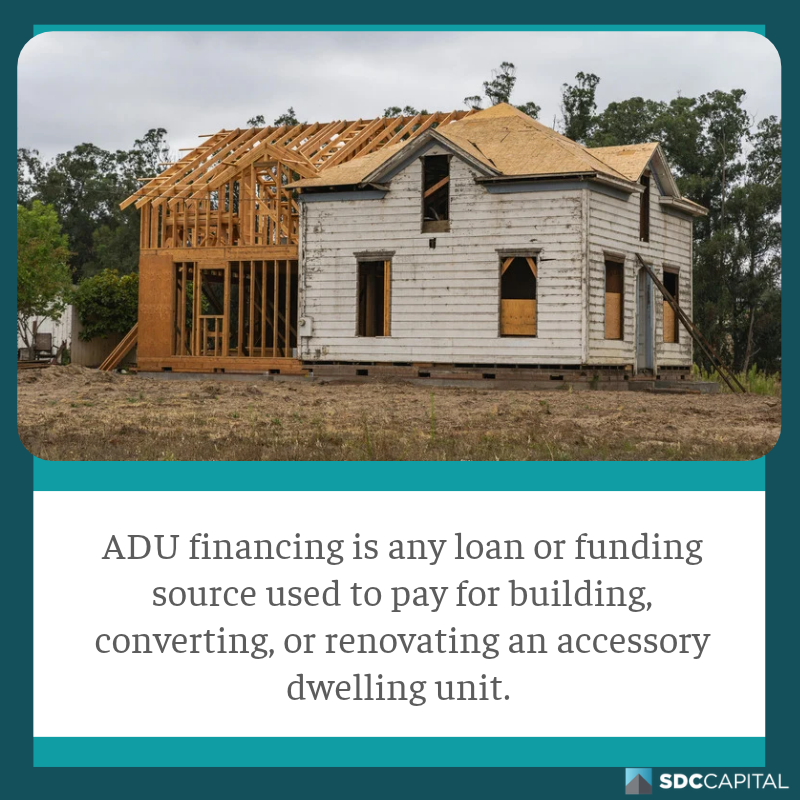
ADU financing is any loan or funding source used to pay for building, converting, or renovating an accessory dwelling unit.
An ADU is a self-contained residential unit with its own space for living, sleeping, cooking, and sanitation, located on the same lot as a primary home or multifamily building.
In California, ADUs generally fall into a few categories:
Detached ADUs: A new standalone unit, such as a backyard cottage.
Attached ADUs: A unit built onto the primary dwelling, such as a second story or an addition over a garage.
Converted ADUs: Existing space turned into a unit, such as a garage, basement, or storage area.
Junior ADUs (JADUs): A unit of up to 500 square feet created within a single-family home.
ADU financing covers more than construction labor and materials. A complete budget typically includes architectural plans, engineering, permit and utility fees, site work, finishes, and a contingency reserve.
The right ADU financing structure depends on how much equity the property holds, how fast the project needs to start, and how the investor plans to repay the loan.
How ADU Financing with Hard Money Works
Hard money ADU financing is a form of private lending.
Instead of relying mainly on personal income and credit scores, a private lender underwrites the deal based on the real estate itself and the strength of the project plan.
Structurally, it works much like a residential bridge loan: short-term capital that carries the property through a transition until a sale or permanent financing takes over.
Loan Sizing Based on After-Repair Value
Many private lenders size ADU financing using the property's projected after-repair value (ARV), meaning what the property should be worth once the ADU is finished.
This matters because bank products like HELOCs and cash-out refinances are based on current value, which can leave investors short on funds.
Here is a simplified, hypothetical example:
Current property value: $850,000
Existing loan balance: $550,000
ADU construction budget: $200,000
Projected value after the ADU is built: $1,150,000
A HELOC capped at 85% of current value would allow total debt of $722,500, leaving about $172,500 available, which is not enough to cover the build.
A lender sizing the loan at 70% of the projected value would allow total financing of $805,000, leaving roughly $255,000 of capacity after the existing balance. Actual leverage, appraisal results, and terms vary by lender and deal.
Draw Schedules
Construction funds are rarely released all at once. Most hard money ADU financing uses a draw schedule tied to project milestones, such as foundation, framing, rough-in, and final inspection.
The contractor completes a phase, the lender verifies the work (often through an inspection), and the next portion of funds is released.
This protects both the investor and the lender by keeping funding aligned with progress.
Interest-Only Payments
Hard money loans are commonly structured with interest-only monthly payments. During construction, the ADU is not producing rent yet, so lower payments help preserve cash flow until the unit is leased or the property is sold or refinanced.
Short Terms and Fast Closings
Hard money ADU financing usually runs 6 to 24 months, which matches a typical design-permit-build timeline.
Because underwriting focuses on the asset, private lenders can often close in days or weeks rather than the 30 to 60 days common with banks. SDC CAPITAL can fund qualified deals in as fast as 7 days.
When Hard Money Makes Sense for ADU Financing
Hard money is not the cheapest form of ADU financing, so it works best when speed, flexibility, or property type matter more than the lowest rate.
Adding Rental Units to Investment Properties
California law is favorable to ADU rentals. Per the HCD ADU Handbook, local agencies cannot impose owner-occupancy requirements on ADUs, although they may require rentals to run longer than 30 days.
That makes ADUs a practical way for landlords to add long-term rental income to an existing property. Many conventional ADU loan programs are built around owner-occupied homes, while private lenders focus on investment properties.
Multifamily and Multi-ADU Projects
State law now allows owners of existing multifamily properties to build up to eight detached ADUs, as long as the number does not exceed the existing units on the lot, plus converted ADUs inside non-livable space such as storage rooms or garages.
Agency financing has not kept pace with these projects. Fannie Mae's ADU guidelines state that ADUs are not eligible on 2 to 4 unit dwellings and that properties with multiple ADUs are ineligible.
For investors adding units to a duplex, fourplex, or apartment building, private ADU financing is often one of the few workable options.
Value-Add Before a Sale
Some investors build an ADU to increase a property's resale value before listing. Short-term hard money ADU financing fits this plan because the loan is repaid from the sale proceeds once the unit is complete.
Time-Sensitive Starts
If plans are approved and a contractor is ready, waiting weeks for bank underwriting can push the project back and raise costs.
Hard money can keep the schedule on track. It can also help investors keep cash available for other deals, a trade-off covered in our guide on hard money vs. cash.
Borrowers Outside Bank Guidelines
Self-employed investors, borrowers with complex income, or those holding properties in an LLC may struggle with bank debt-to-income rules. Asset-based ADU financing gives these borrowers a path based on the property and project.
ADU Financing Requirements for Private Loans
Every lender has its own criteria, but a clear, well-documented budget is one of the first things private lenders review. For a broader look at eligibility, see who qualifies for a hard money loan who qualifies for a hard money loan.
A Realistic Budget
A detailed contractor bid, scope of work, and timeline are central to ADU financing approval.
Costs vary widely by region and design. A UC Berkeley Center for Community Innovation survey of California ADU owners found a statewide median construction cost of $150,000, or $250 per square foot, though current costs in high-cost markets can run well above that. Building a 10% to 20% contingency into the budget is a common practice.
Hard Money vs. Other ADU Financing Options
Hard money is one of several ADU financing paths. The table below compares the most common options for California investors.
| Option | Based On | Typical Speed | Works for Investment or Multi-Unit Properties | Best For |
|---|---|---|---|---|
| Hard money / private loan | Property value and projected ARV | Days to a few weeks | Yes | Investors who need speed, flexibility, or financing on properties banks exclude |
| HELOC | Current home equity | Several weeks | Limited, mostly primary residences | Owners with substantial existing equity and flexible timelines |
| Cash-out refinance | Current home value | 30 to 60 days | Possible, with stricter terms | Owners who can replace their first mortgage without losing a lower rate |
| Bank construction loan | Future value, with strict draw oversight | 30 to 60+ days | Varies by bank | Borrowers with strong income and documentation |
| Renovation loans (Fannie Mae HomeStyle, FHA 203(k)) | Future value, agency guidelines | 30 to 60+ days | Mostly 1-unit, owner-focused properties | Buyers or owners of single-family homes |
A few details stand out for investors:
HELOCs and cash-out refinances depend on equity you already have, which can fall short when the build costs more than your available equity.
Bank construction loans can be based on future value but often involve heavier documentation and slower approvals. Compare pricing in our breakdown of construction loan rates.
Renovation loans have limits. Per HCD, the FHA 203(k) program can only fund attached ADUs, and Fannie Mae's programs exclude 2 to 4 unit properties and multiple ADUs.
Grants are not a reliable source right now. HCD notes that funds for CalHFA's ADU Grant Program, which offered up to $40,000 for predevelopment costs, have been exhausted.
The trade-off with hard money is cost. Rates and fees are higher than bank financing, so it works best when the project timeline is short and the exit strategy is clear.
Work with SDC CAPITAL on Your ADU Financing
SDC CAPITAL is a California private lender that funds real estate investors with fast, flexible financing.
Whether you are adding a detached ADU to a rental, converting space in a multifamily building, or improving a property before a sale, our team structures ADU financing around your project and exit plan.
Asset-based underwriting focused on the property and project
Loan sizing that considers projected value
Interest-only options during construction
Funding in as fast as 7 days for qualified deals
Have an ADU project in mind? Send your deal details here or call 424-304-1072 to speak with a loan officer.
FAQs About ADU Financing
Can you get a hard money loan to build an ADU?
Yes. Private lenders offer short-term ADU financing for investment properties, typically sized on the property's value and the projected value after construction. Funds are usually released through a draw schedule.
How fast can I get ADU financing with hard money?
Hard money ADU financing can close in days to a few weeks, depending on the lender, appraisal, and how complete your plans and permits are. Banks commonly take 30 to 60 days or longer.
Do I need permits before getting ADU financing?
Most lenders want approved or submitted plans and permits before funding construction. Unpermitted projects are a common reason ADU financing requests are declined.
Can I build an ADU on a multifamily property in California?
Yes. State law allows up to eight detached ADUs on a lot with an existing multifamily building, capped at the number of existing units, plus conversion ADUs in non-livable space.
Because agency programs exclude many of these projects, investors often turn to private ADU financing.
Is hard money ADU financing available for owner-occupied homes?
Hard money lenders primarily fund investment and business-purpose properties. Owner-occupied loans are subject to additional consumer lending rules, so homeowners building an ADU for personal use often look at HELOCs, cash-out refinances, or renovation loans first.