
Key Takeaways
A ground up construction loan funds a brand-new building on raw or cleared land, with money released in stages as work is completed.
Private lenders focus on total project cost, after-repair value, builder experience, permits, and a clear exit, more than personal income.
California adds its own layer of review: local plan check, SB 9 and ADU rules, CSLB-licensed contractors, and fire-zone building codes.
SDC CAPITAL funds mid-construction projects in Southern California, helping builders complete projects that are already underway.
California authorized roughly 9,087 new private housing units by building permit in August 2026 alone, according to U.S. Census Bureau data. Every one of those units started with a lot, a set of plans, and a way to pay for the build.
For most investors and developers, that last piece is a ground up construction loan. This guide covers what lenders require, the California-specific factors that affect approval, and how private and bank qualification differ, so you can prepare a stronger application before you apply.
What Is a Ground Up Construction Loan?
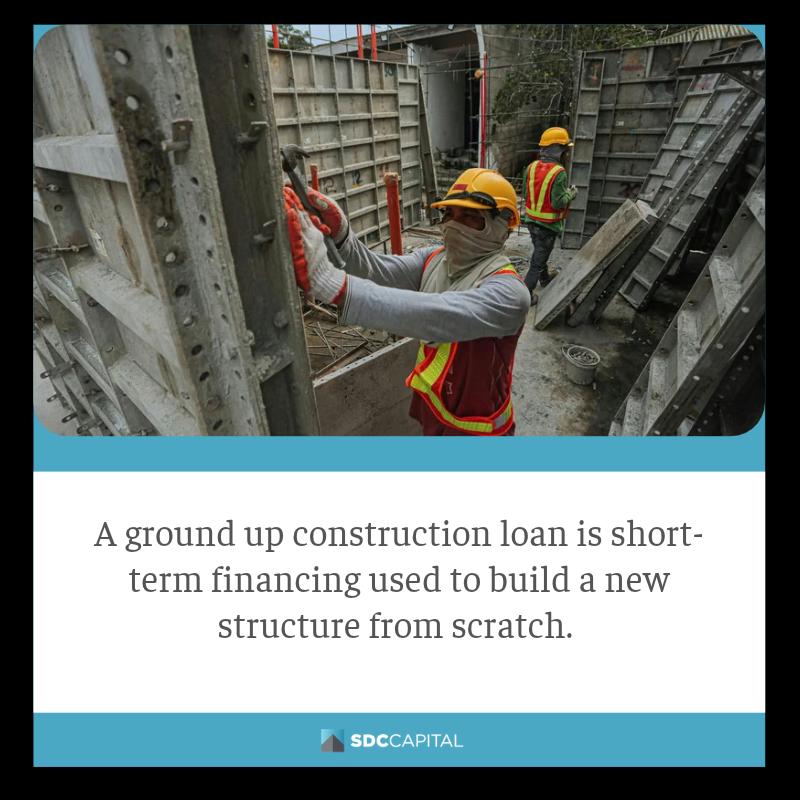
A ground up construction loan is short-term financing used to build a new structure from scratch.
Depending on the program, it can cover land acquisition, hard costs (labor, materials, and site work), and soft costs (architecture, engineering, and permit fees).
The key difference from a purchase loan is the collateral. At closing, the finished property doesn't exist yet. That is why underwriting reviews the project plan as closely as the land itself.
Common borrowers include:
Investors building spec homes to sell
Developers building small multifamily or townhome projects
Owners adding new units on SB 9 lots or ADUs on rental properties
Builders who already own land and need capital to start vertical construction
If you are weighing a shorter-term option for the same project, see how a bridge loan for new construction compares.
How Does a Ground Up Construction Loan Work?
A ground up construction loan follows the life of the project instead of paying out in one lump sum.
1. Closing and initial funding. At closing, the ground up construction loan funds the land portion (if included) and sometimes early soft costs.
2. Construction draws. The rest of the loan is held back and released in draws tied to milestones such as foundation, framing, rough-in, and final.
An inspector usually confirms the work before each draw. Many programs reimburse completed work, so builders should have cash on hand to cover costs between draws.
3. Interest-only payments. Borrowers typically pay interest only on the funds drawn, not on the full loan amount. Some programs include an interest reserve that covers payments during the build.
4. Term. Most ground up construction loan terms run 12 to 24 months.
5. Exit. The loan is repaid when the property sells, or refinanced into long-term financing once the certificate of occupancy is issued.
Pricing varies by lender, leverage, and project risk. Our guide to California construction loan rates explains what drives your final rate.
Ground Up Construction Loan Requirements in California
Guidelines vary, but most ground up construction loan programs review the same core areas.
| Requirement | What Lenders Typically Look For |
|---|---|
| Equity / Loan-to-Cost (LTC) | Borrower contributes about 15% to 25% of total project cost; many lenders cap LTC around 75% to 85% |
| After-Repair Value (ARV) | Loan capped at a percentage of the completed property's value |
| Credit | Often 680 or higher; some asset-based programs have no minimum |
| Experience | Prior completed builds, or a licensed, experienced general contractor |
| Plans and Budget | Approved plans, a line-item budget, and a realistic timeline |
| Permits and Zoning | Permits issued or ready to issue, with zoning confirmed |
| Insurance | Builder's risk coverage and contractor liability insurance |
| Reserves | A contingency of 10% to 15% plus funds for interest and holding costs |
| Exit Strategy | Sale comps or a documented refinance plan |
Equity and Loan-to-Cost
Loan-to-cost compares the loan amount to the total cost of land, hard costs, and soft costs.
If a project costs $1,000,000 and the loan covers 80% LTC, the borrower covers $200,000. Land you already own often counts toward your equity.
After-Repair Value
The loan is also capped against the projected value of the finished property. This protects both sides if costs rise or the market softens. Learn how to calculate ARV before you build your budget.
Credit and Financial Strength
Banks weigh credit score, income, and debt-to-income ratio heavily. Private lenders place more weight on the deal itself, but they still review liquidity to confirm you can carry costs between draws.
Builder Experience and Your General Contractor
Underwriters want proof the team can finish. Experienced builders can show completed projects. Newer investors can qualify by hiring a licensed general contractor with a solid track record and providing the signed construction contract.
Plans, Budget, and Contingency
A vague budget is one of the most common reasons a ground up construction loan stalls in underwriting.
Submit architectural plans, a line-item budget from your contractor, a build schedule, and a contingency line. A 10% to 15% contingency is a common benchmark for unexpected costs.
Exit Strategy
State how the loan will be repaid. For a sale, include comparable sales near the site. For a hold, show expected rents and a refinance plan.
California Factors That Affect Approval
California projects carry requirements that out-of-state guides rarely mention. Expect each one to come up when you apply for a ground up construction loan here.
Permits and Plan Check
Most programs will not fund vertical construction until permits are issued. Local plan-check timelines differ by city, so build permit time into your schedule and your interest budget.
SB 9 Lots and ADUs
SB 9 allows two-unit developments and urban lot splits on many single-family lots, which has opened new small-scale ground-up opportunities. The state's SB 9 fact sheet from HCD explains eligibility, and the HCD ADU Handbook covers ADU standards.
Underwriting will confirm the unit count your lot supports before approving the scope. For rental owners, our guide to ADU financing with hard money covers how these builds are funded.
CSLB-Licensed Contractors
The Contractors State License Board urges property owners to hire licensed contractors for construction projects of $1,000 or more. Expect underwriters to verify your contractor's CSLB license number as part of underwriting.
Fire Hazard Severity Zones
New construction in High and Very High Fire Hazard Severity Zones must meet the ignition-resistant building standards in Chapter 7A of the California Building Code.
These requirements can raise material costs and affect insurance, so check your site's zone before you finalize the budget.
Private Lender vs. Bank: How Qualification Differs
Both can fund a ground up construction loan, but they evaluate borrowers differently.
Banks focus on the borrower. Expect tax returns, W-2s or business financials, debt-to-income limits, strong credit, and longer approval timelines. Banks often prefer builders with deep track records and may require significant cash reserves.
Private lenders focus on the asset and the plan. Underwriting centers on the land, the budget, the ARV, and the exit. Documentation is lighter, credit standards are more flexible, and closings are faster.
The tradeoff is pricing: private loans usually carry higher rates and origination fees.
For investors whose income is spread across properties and entities, or who need to close quickly, a private ground up construction loan is often the more practical option.
How SDC CAPITAL Can Help
Not every project needs financing at groundbreaking. Some builders start with their own capital, hit a funding gap, or have a lender pull back mid-build.
SDC CAPITAL focuses on these mid-construction projects, providing the capital needed to carry a project through to completion.
SDC CAPITAL's construction loan program offers:
Loan amounts from $250,000 to $5,000,000
Residential and commercial non-owner-occupied properties
Terms of 6 to 24 months, in first lien position
Rates starting at 9.99%, with origination of 1.5% to 2.5%
Up to 65% of ARV
No minimum FICO score
Funding in as few as 10 to 14 days
Lending across Southern California
With over 35 years of experience as a real estate developer, SDC CAPITAL understands construction timelines, draw schedules, and the pressure of keeping a job site moving.
Ready to Finish Your Project?
If your California build is already underway and you need capital to complete it, SDC CAPITAL can review your deal quickly.
📞 Call 424-304-1072 or get a quote today.
FAQs About Ground Up Construction Loans
What credit score do you need for a ground up construction loan?
It varies. Banks and many private programs look for 680 or higher, while some asset-based options, including SDC CAPITAL, have no minimum FICO score.
How much down payment is required for a ground up construction loan?
Most programs expect 15% to 25% of total project cost. Land you already own can often count toward that equity.
Can a first-time builder get a ground up construction loan?
Yes, in many cases. A first-time builder is typically required to hire an experienced, licensed general contractor and submit detailed plans and a budget.
How long does a ground up construction loan last?
Most ground up construction loan terms run 12 to 24 months, with interest-only payments during construction.
Can I use a ground up construction loan to build an ADU in California?
Yes. Many investors use construction financing to add ADUs or SB 9 units to existing lots, as long as the scope fits state and local rules.