
Key takeaways
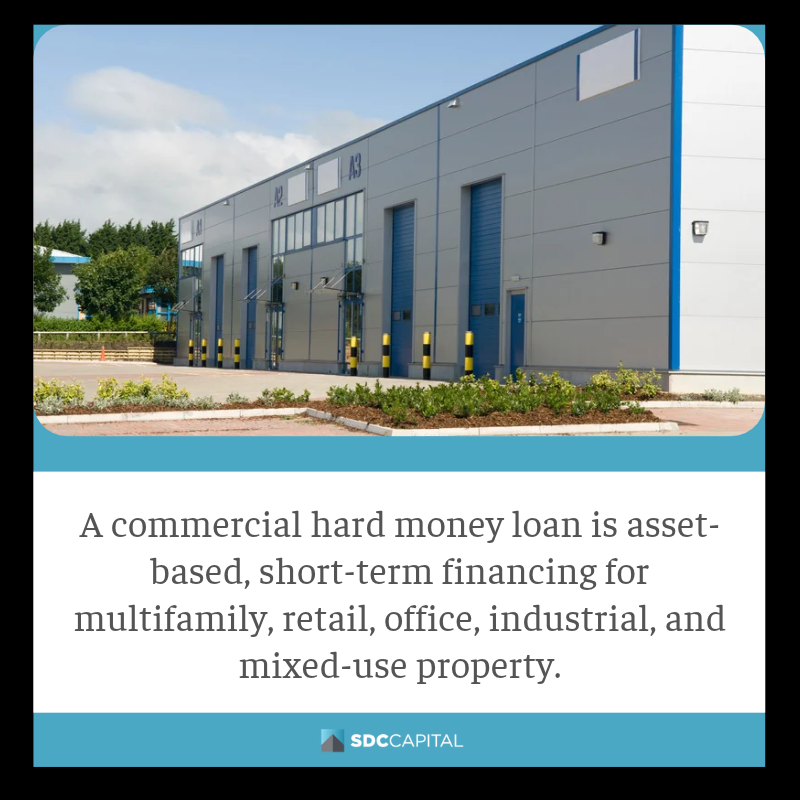
A commercial hard money loan is asset-based, short-term financing for multifamily, retail, office, industrial, and mixed-use property.
It fits deals that banks pass on because of vacancy, timing, condition, or a maturing loan.
SDC CAPITAL lends $250K to $5M at about 65% LTV on stabilized property and up to 75% LTV on value-add purchases, in first or second position.
Most loans run 12 to 18 months, so the exit (refinance or sale) is planned before closing.
A clear deal summary, rent roll, and exit plan are what get a request approved quickly.
A commercial hard money loan is short-term financing secured by income-producing or business-use property, such as multifamily buildings, retail centers, office buildings, and industrial space. The lender sizes the loan mainly on the property's value and the borrower's exit plan, not on bank-style credit and income ratios.
That makes a commercial hard money loan less of a general-purpose product and more of a tool for specific deal problems.
Instead of a standard definitions list, this guide walks through six situations where California investors, borrowers, and brokers use one, with the numbers behind each.
Commercial Hard Money Loan Quick Facts
| Term | Typical Range |
|---|---|
| Loan amount | $250K to $5M (SDC CAPITAL) |
| Loan-to-value | About 65% stabilized; up to 75% on value-add purchases |
| Lien position | First or second lien |
| Loan term | 12 to 18 months |
| Interest rate | Starting at 8.99% |
| Time to close | Often 1 to 3 weeks, depending on appraisal and title |
| Property types | Multifamily, retail, office, industrial, mixed-use |
| Primary market | California |
6 Situations Where a Commercial Hard Money Loan Fits
The six situations below are the ones California borrowers and brokers bring to private lenders most often, each with an example of how the loan is sized.
Situation #1: The Property Isn't Stabilized Yet
Banks want in-place income that covers the debt today. A strip center at 60% occupancy, or an apartment building with deferred maintenance, often fails that test even when the plan to lease it up is solid.
That gap has widened.
In the Federal Reserve's October 2026 Senior Loan Officer Opinion Survey, banks reported tighter lending standards and weaker demand across every commercial real estate loan category, including construction, nonfarm nonresidential, and multifamily.
A commercial hard money loan is sized on the property's value and the business plan instead. On a value-add purchase, SDC CAPITAL can lend up to 75% LTV. On a $3,000,000 strip center, that is a loan of up to $2,250,000, with the buyer bringing $750,000 plus closing costs.
Vacancy alone isn't a dealbreaker in this market. Cushman & Wakefield's Q3 2026 U.S. Retail MarketBeat put national retail vacancy at 5.9%, so well-located centers with a leasing gap are often a timing problem, not a demand problem.
Real example: SDC CAPITAL funded a $2,000,000 cash-out refinance on a 12-unit retail strip center in Downey at 66.2% LTV with a 12-month term.
The repeat client plans to lease the remaining vacant units and then sell, with an estimated after-repair value of about $3.3 million.
For more on financing centers like this, see our guide to the retail property loan.
Situation #2: Your Bank Loan Is Maturing and the Refinance Isn't Ready
A maturing loan is one of the most common reasons owners call a hard money lender.
According to the Mortgage Bankers Association, about $875 billion, or 17% of the $5.0 trillion in outstanding commercial mortgages, is scheduled to mature in 2026.
When the existing lender won't extend and the property's income doesn't yet support a new bank loan, a commercial hard money loan pays off the maturing debt and buys time to lease up, renew tenants, or rebuild the debt service coverage ratio.
This is where the line between products gets blurry.
A commercial bridge loan describes the purpose (bridging to permanent financing or a sale), while a commercial hard money loan describes the lending approach (asset-based, private capital).
Many loans are both. Either way, the lender will want a clear exit strategy before funding.
Situation #3: You Need to Close in Weeks, Not Months
Competitive offers, seller deadlines, and auction purchases don't wait for a 60-day bank process. A commercial hard money loan can often close in one to three weeks because underwriting centers on the property and the decision is made in-house.
Speed matters most in a 1031 exchange. Under IRS rules, an investor has 45 days from the sale of the relinquished property to identify replacement property, and 180 days to close.
If the replacement property is a partially vacant center or a building a bank won't finance on schedule, short-term private financing can keep the exchange on track until a permanent loan is in place.
Situation #4: You Want Equity Out Without Touching a Low-Rate First Mortgage
Many California owners hold commercial property with a first mortgage they don't want to refinance. Replacing a low fixed rate just to pull out equity rarely makes sense.
A second lien commercial hard money loan sits behind the existing first and is sized on combined loan-to-value (CLTV).
Example: A mixed-use building is worth $4,000,000 with a $1,600,000 first mortgage (40% LTV). At a 65% CLTV limit, total debt can reach $2,600,000, which leaves room for a second lien of up to $1,000,000.
The owner keeps the original first mortgage and uses the proceeds for a purchase, renovation, or another project.
Second lien loans typically price higher than first lien loans because the lender is repaid after the senior lender.
Situation #5: A Partner Wants Out
Partnership breakups are time-sensitive and hard to explain to a bank credit committee. One partner wants to cash out, the other wants to keep the asset, and the property's numbers may be in transition.
Office is a good example. Cushman & Wakefield's Los Angeles Office MarketBeat reported direct office vacancy in Los Angeles rising to 21.3% in Q3 2026. That kind of backdrop makes bank refinancing slow, even for a reasonably leased building.
A commercial hard money loan can fund the buyout based on the property's current value. The remaining owner then has 12 to 18 months to stabilize, re-tenant, or sell, and refinance into long-term debt once the numbers support it.
Situation #6: A Construction Project Stalled Midway
Projects stall for ordinary reasons: a cost overrun, a lender that pulled back, or a draw schedule that no longer matches the work. Construction lending is under pressure on several fronts.
The Fed survey above showed tighter bank standards on construction and land development loans, and UCLA Anderson Forecast reported that California construction activity weakened entering the second half of 2026.
SDC CAPITAL funds mid-construction projects, not raw-land ground-up deals. A commercial hard money loan can pay off the existing construction lender and fund the remaining budget, provided the work in place, permits, and a realistic completion plan support the value.
Lenders will review the original budget, what has been spent, what remains, and who is finishing the job.
What Every Situation Has in Common: How Lenders Size the Deal
Each situation above is different, but a commercial hard money loan lender asks the same core questions.
Property value. The lender uses an appraisal or valuation to set the as-is value, and sometimes the stabilized or after-repair value for value-add plans.
Leverage and lien position. LTV on first lien loans and CLTV on second lien loans determine the maximum loan. At SDC CAPITAL, that is about 65% on stabilized property and up to 75% on value-add purchases.
Income and risk metrics. Even on a non-stabilized property, lenders look at current rent, leases, and debt yield to understand downside risk.
The exit. A 12 to 18 month loan needs a credible path to payoff, usually a refinance or a sale. Lenders test whether projected income will meet a permanent lender's requirements by maturity.
The sponsor. Credit matters less than with a bank, but experience with similar properties, liquidity for reserves, and a clean explanation of any past issues still count.
Preparing Your Commercial Hard Money Loan Request
A complete package is the fastest way to a term sheet. Brokers who send these items up front usually get quicker, firmer answers.
One-page deal summary: property, address, loan amount, purpose, and timeline
Sources and uses: where every dollar comes from and where it goes
Rent roll and trailing 12-month operating statement (T-12)
Purchase contract, or the payoff statement for the loan being refinanced
Renovation or construction budget, with work completed to date if mid-construction
Exit plan: target refinance amount or sale price, and the timing
Entity documents and sponsor background: experience, liquidity, and similar deals completed
Get a Commercial Hard Money Loan Quote From SDC CAPITAL
SDC CAPITAL provides commercial hard money loans from $250K to $5M for multifamily, retail, office, and industrial properties across California, in first or second lien position.
Whether you're buying a value-add center, paying off a maturing loan, or finishing a stalled project, our team can review your deal and respond quickly.
Request a quote or call 424-304-1072 to talk through your deal.
Frequently Asked Questions
What is a commercial hard money loan?
A commercial hard money loan is a short-term, asset-based loan secured by commercial property, such as multifamily, retail, office, or industrial buildings. Private lenders base approval mainly on the property's value and the exit plan rather than the borrower's income and credit.
What are commercial hard money loan rates?
At SDC CAPITAL, rates start at 8.99%. The final rate depends on leverage, lien position, property type, and the strength of the exit plan.
How much down payment do I need for a commercial hard money loan?
Expect to bring 25% to 35% of the purchase price. At SDC CAPITAL, value-add purchases can go up to 75% LTV, which means a 25% down payment plus closing costs.
How fast can a commercial hard money loan close?
Many close within one to three weeks. Timing depends mostly on the appraisal, title, and how quickly the borrower provides documents.
Is a commercial hard money loan the same as a bridge loan?
They overlap. "Bridge loan" describes the purpose, which is short-term financing until a refinance or sale. "Hard money" describes the lender type and approach. Most commercial hard money loans are used as bridge financing.
Can a commercial hard money loan be in second position?
Yes. A second lien commercial hard money loan sits behind an existing first mortgage and is sized on combined loan-to-value. It lets owners access equity without refinancing a low-rate first loan.