
Key Takeaways
Value-add multifamily financing typically uses a short-term bridge loan to fund the acquisition and renovation of an underperforming apartment property.
Conventional and agency lenders underwrite current income, so properties with high vacancy or deferred maintenance usually do not qualify until they stabilize.
Bridge financing is interest-only, closes faster than a bank loan, and can include renovation funds released in draws.
Higher rents raise net operating income (NOI), and NOI drives property value, which is what makes the refinance possible.
The most common mistakes are underestimating renovation costs, projecting rents too aggressively, and choosing a loan term that is too short for the business plan.
An older apartment building with dated units, below-market rents, and a few vacancies is often priced for what it earns today, not what it could earn after improvements. That gap is where value-add investors make their return.
The challenge is financing it, because most long-term lenders will not lend on a property that is still in transition.
Value-add multifamily financing solves that problem with a short-term bridge loan that covers the purchase and renovation period, followed by a refinance into permanent debt once the property performs. Lenders are actively funding this space: the Mortgage Bankers Association projects multifamily originations will reach $399.2 billion in 2026, up from $330.6 billion in 2025.
This guide explains how value-add multifamily financing works, why a bridge loan fits the strategy, and what California investors should plan for before they close.
What Is Value-Add Multifamily Financing?
Value-add multifamily financing is capital used to buy an apartment property below its potential value, improve it, and capture the increase in income and value.
The improvements can be physical (unit interiors, roofs, plumbing, common areas) or operational (better management, tighter expense control, filling vacant units).
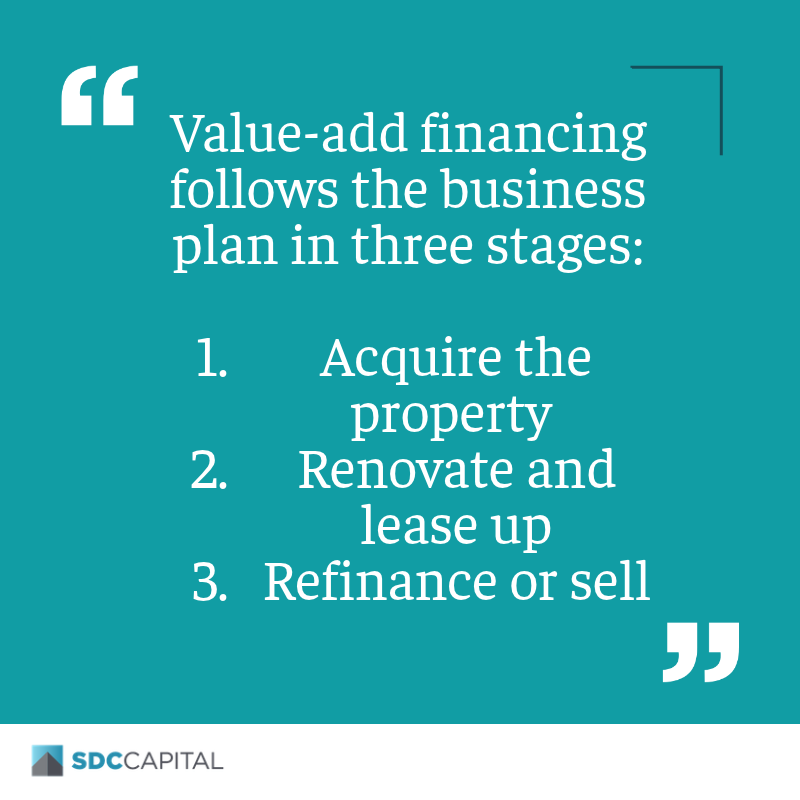
The financing follows the business plan in three stages:
Acquire the property with a bridge loan sized to the purchase price or as-is value.
Renovate and lease up while making interest-only payments.
Refinance or sell once the property reaches stable occupancy and higher rents.
The same approach applies to buildings with both residential and commercial space. If the property includes ground-floor retail, see our guide to mixed-use financing for how lenders treat blended income.
Why Conventional and Agency Lenders Pass on Value-Add Deals
Banks, Fannie Mae, and Freddie Mac prefer stabilized properties. They size loans on in-place income and want to see that the property can cover its debt payments from day one, usually measured by the debt service coverage ratio (DSCR).
A value-add property often fails that test for predictable reasons:
Occupancy is low. Vacant or down units do not produce rent.
Rents are below market. Existing leases reflect the property's current condition, not its potential.
The property needs work. Deferred maintenance or outdated systems raise the lender's risk.
Income will change. Renovating units often means temporarily lower cash flow before rents rise.
Traditional underwriting also takes time and requires full financial documentation, which can cost an investor a competitive deal.
This is why value-add multifamily financing usually starts with a private or bridge lender rather than a bank.
How a Bridge Loan Works for Value-Add Multifamily
In value-add multifamily financing, a bridge loan carries the investor from closing through renovation and lease-up, then gets repaid when the property refinances or sells.
Acquisition
The bridge lender funds a percentage of the purchase price or appraised as-is value, whichever is lower.
Across the market, value-add bridge loans commonly fall in the 65% to 80% loan-to-cost range, depending on the sponsor, the property, and the renovation scope. Bridge lenders also focus on the property's value and the investor's exit plan, not just current cash flow.
Renovation Holdback
Some lenders include a renovation holdback. Instead of advancing all renovation funds at closing, the lender sets money aside and releases it in draws as work is completed and inspected.
Draws can take time, so investors should plan contractor payments around the release schedule. Other structures fund the purchase only, with the investor covering renovation costs from their own capital.
Interest-Only Payments
Most bridge lenders require interest-only payments during the term. This keeps monthly costs lower while the property is producing less income, which leaves more cash for renovations and reserves.
Term
Terms for value-add multifamily financing typically run 12 to 36 months, often with extension options. The term should match the realistic renovation and lease-up timeline, plus a cushion for delays.
The Exit: Refinancing Into Permanent Debt
Once the property stabilizes, the investor refinances into a long-term loan from a bank, a DSCR lender, or an agency program. For smaller apartment buildings, agency options have shifted recently.
In April 2026, Freddie Mac launched its Conventional Small product for loans under $10 million, replacing its former Small Balance Loan program. Investors with smaller exits should confirm which permanent loan programs fit their expected loan size before they buy.
How and Why It Works: The NOI and Valuation Math
Value-add multifamily financing works because commercial property value follows income. Apartment buildings with five or more units are generally valued by dividing net operating income by the market cap rate. Raise the NOI and the value rises with it.
This matters in California, where market rent growth alone may not carry a deal. In Los Angeles, for example, effective rent reached $2,887 in Q2 2026, up only 0.8% year over year.
With market rents growing slowly, value-add investors create growth by improving the property rather than waiting for the market.
Worked Example: 12-Unit Building
The figures below are illustrative and assume a 5.5% cap rate.
| Metric | Before Renovation | After Stabilization |
|---|---|---|
| Average rent per unit | $2,200 | $2,550 |
| Annual gross rent (12 units) | $316,800 | $367,200 |
| Operating expenses | $126,720 | $132,000 |
| Net operating income | ~$190,000 | ~$235,000 |
| Value at 5.5% cap rate | ~$4.27 million | ~$4.27 million |
In this scenario:
The investor buys the building for $3.2 million because of its condition and below-market rents.
A bridge loan at 75% of the purchase price provides $2.4 million.
The investor spends $360,000 ($30,000 per unit) on renovations.
After stabilization, NOI rises by about $45,000, which adds roughly $818,000 in value at the same cap rate.
Value-Add Multifamily Financing: Common Mistakes to Avoid
Value-add multifamily financing gives investors flexibility, but the business plan still has to hold up. These are the mistakes that most often cause problems.
1. Underestimating Renovation Costs
Material costs have risen quickly. Construction input prices rose 11.2% from September 2025 to September 2026, according to Associated Builders and Contractors.
Get multiple contractor bids, build in a contingency of at least 10%, and confirm prices close to the start date.
2. Projecting Rents Too Aggressively
Base rent projections on comparable renovated units in the same submarket, not the highest rent in the area. In California, also account for rent caps.
The statewide Tenant Protection Act (AB 1482) limits annual increases for many covered units, and cities such as Los Angeles have their own rent stabilization rules. These can slow how quickly in-place rents reach market levels.
3. Choosing a Loan Term That Is Too Short
If renovation and lease-up will take 18 months, a 12-month loan with no extension creates pressure at maturity. Match the term to a realistic timeline and ask about extension options and fees upfront.
4. Holding Too Little in Reserves
Permit delays, hidden damage, and slow lease-up are common. Keep cash reserves beyond the renovation budget to cover interest payments and surprises.
5. Choosing a Lender on Rate Alone
The lowest rate does not help if the lender cannot close on time or does not understand multifamily. Review our list of questions to ask hard money lenders before you commit.
Work With SDC CAPITAL on Your Value-Add Multifamily Financing
SDC CAPITAL is a California-based private lender that provides bridge financing for investors repositioning income properties. For value-add multifamily financing, our programs include:
Loan amounts: $250,000 to $5 million
Leverage: Up to 75% LTV on value-add purchases (about 65% LTV on stabilized properties)
Lien position: First and second liens
Terms: Typically 12 to 18 months
Property types: Multifamily, retail, office, and industrial properties
Geography: Primarily California
Our team reviews the property, the business plan, and the exit strategy together, so you get a clear answer early in the process.
Have a value-add multifamily deal? Request a quote here or call 424-304-1072.
FAQs About Value-Add Multifamily Financing
What is value-add multifamily financing?
Value-add multifamily financing is short-term capital, usually a bridge loan, used to buy and improve an underperforming apartment property. Once the property stabilizes at higher rents, the investor refinances into long-term debt or sells.
How much can I borrow for a value-add multifamily deal?
It depends on the lender, the property, and your experience. Many bridge lenders lend 65% to 80% of total cost. SDC CAPITAL lends up to 75% LTV on value-add purchases, with loan amounts from $250,000 to $5 million.
Can a bridge loan cover renovation costs?
Some value-add multifamily financing programs include a renovation holdback released in draws as work is completed. Others fund the purchase only. Confirm the structure with your lender before you make an offer.
How long does a value-add multifamily project take?
Most projects take 12 to 36 months from purchase to stabilization, depending on the renovation scope, the number of units, and local leasing demand.
Can I use a second lien for value-add multifamily financing?
Yes. If you already own a property with existing debt, a second-position loan can provide capital for renovations without refinancing the first mortgage. SDC CAPITAL offers both first and second liens.
What happens if my property is not stabilized when the bridge loan matures?
Contact your lender early. Many bridge loans offer extension options for a fee, and extensions are easier to arrange before maturity than after.